CHAPTER III — SLAYER
III.1 — The Queen of Fire
There is no prison more cruel than the one that preserves your beauty intact, so that you may behold your hatred in every reflection.
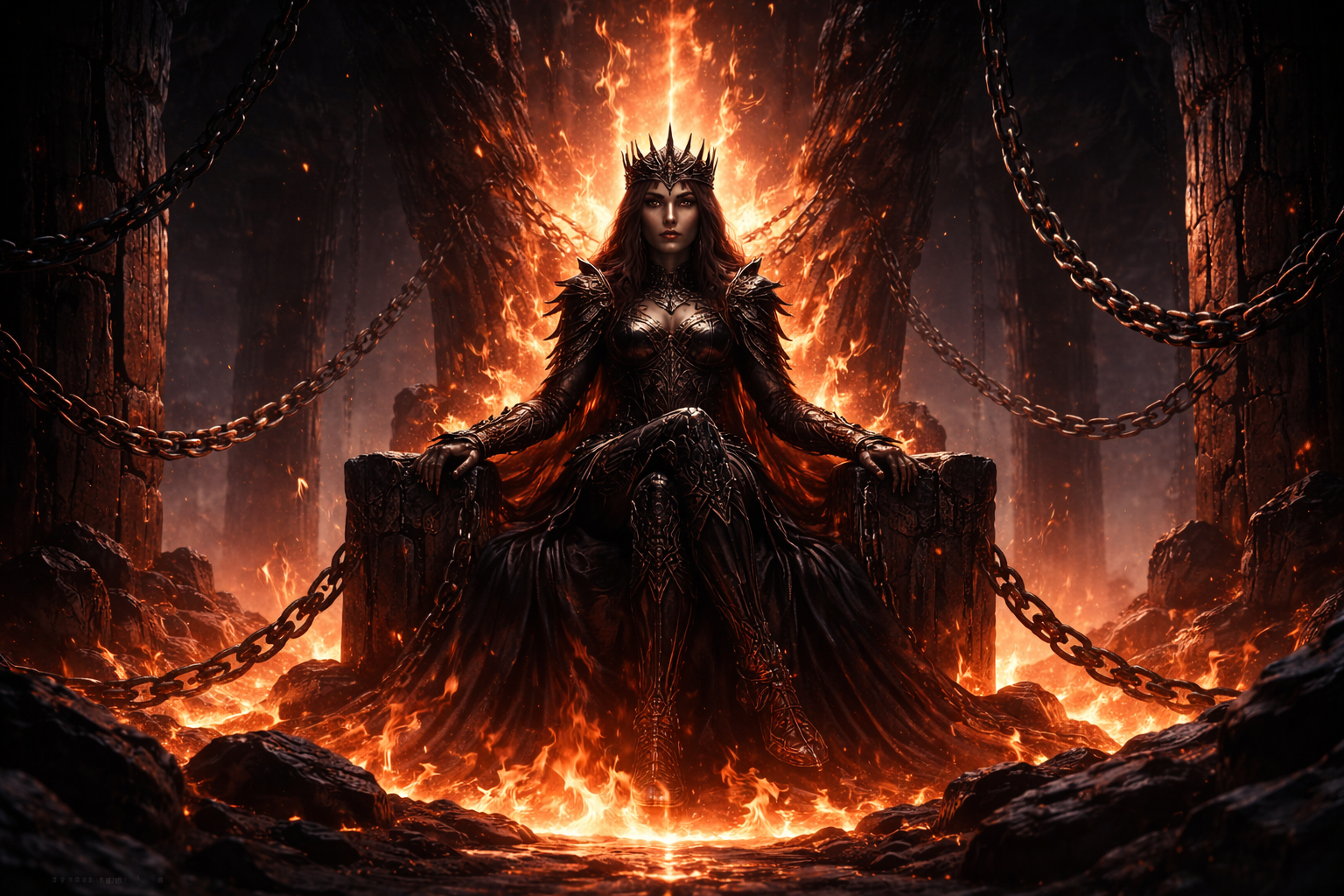
In the depths of Eden, where pressure fractures stone and time no longer has the patience to flow, there stood a nameless chamber — a vault formed of vitrified rock and ancient shadows, where magma was not light, but breath.
At the center of that chamber stood a throne.
Not of gold, not of stone, not of metal.
A throne of fire.
The flames did not dance chaotically, as in primitive worlds. They burned in disciplined forms, like oaths carved in ember, bound to a will that refused to die. Around the throne, ancient chains coiled like tamed serpents, fastened to pillars of basalt and to runes buried deep in the marrow of the planet.
The chains were not merely metal.
They were law.
Upon each link, arcane inscriptions moved slowly, like living script. They were not words for humans. They were formulas for reality — symbols of balance, of limits, of a “no” so absolute that the universe itself acknowledged it.
The inscriptions had been written by ancestors.
Not by the ancestors of Eden.
By the ancestors of Elrond.
In the time of the First Wars, when the worlds touched too often and the dimensional gates were not yet shames kept beneath seals, those warriors of light had descended upon Eden — a world that had once been beautiful and had become a wound.
They had not come to conquer.
They had come to close.
Because she had risen from human ash and surpassed the human. Because her beauty had become a weapon. Because her will had become fire that asked no permission.
Slayer. That was what they called her in the final moment, when her true name was erased.
Daiana. That name no longer existed in the archives. It no longer existed in the songs of the world. It had been removed from stone, from crystal, from memory, as though the very idea of speaking it might fracture the seals.
And yet, she remembered it.
In every thousand years.
In every million breaths of Eden.
In every pulse of the fire that was both her throne and her torment.
Daiana sat unmoving, bound.
Her long chestnut-red hair fell over ritual armor of obsidian and flame like a dark cascade. The dark tiara — her crown — had not been taken, had not been shattered. It had been deliberately left there, an act of elegant cruelty: to remember that you were once queen while being held prisoner.
Her eyes were closed.
Not in sleep.
In patience.
The chains held her, but they did not break her. For Daiana had understood something simple, something light always forgets: if you cannot break the chains today, time remains.
And time is a more faithful ally than any army.
The inscriptions upon the chains could be broken only by the warriors of light.
Only by those who had written them, or by those who carried the same law in their bones.
That had been the final irony: her prison was perfect… until the day perfection would be touched by “good” hands.
In the red darkness, Daiana smiled slowly, without opening her eyes.
And she swore.
Not aloud.
She had no need.
Her oath was older than words.
— Even after thousands of years… I will take my vengeance upon Elrond.
The fire of the throne flickered, as if in approval.
Far away, very far away, in a world born of rules, a perfect flame continued its pulse.
Still.
III.2 — The Name That Could Not Be Spoken
Daiana had not been merely a queen, nor had she ever been merely a symbol.
She had been born on Eden in a period that the archives would later call the Last Equilibrium. The planet’s core still pulsed in a natural rhythm, and fire had not yet been forced into becoming a resource. Her childhood was not exceptional through privilege, but through location: she grew up at the edge of volcanic activity zones, where people learned to live in proximity to fire without attempting to master it.
From her earliest years, Daiana reacted differently to the planet’s pulses. Where others felt discomfort or fear, she felt rhythm. It was not a mystical ability, but a rare sensitivity — a profound attentiveness to subtle environmental variations. She listened more than she spoke. She observed more than she intervened.
That same attentiveness would later bring her close to the dragons.
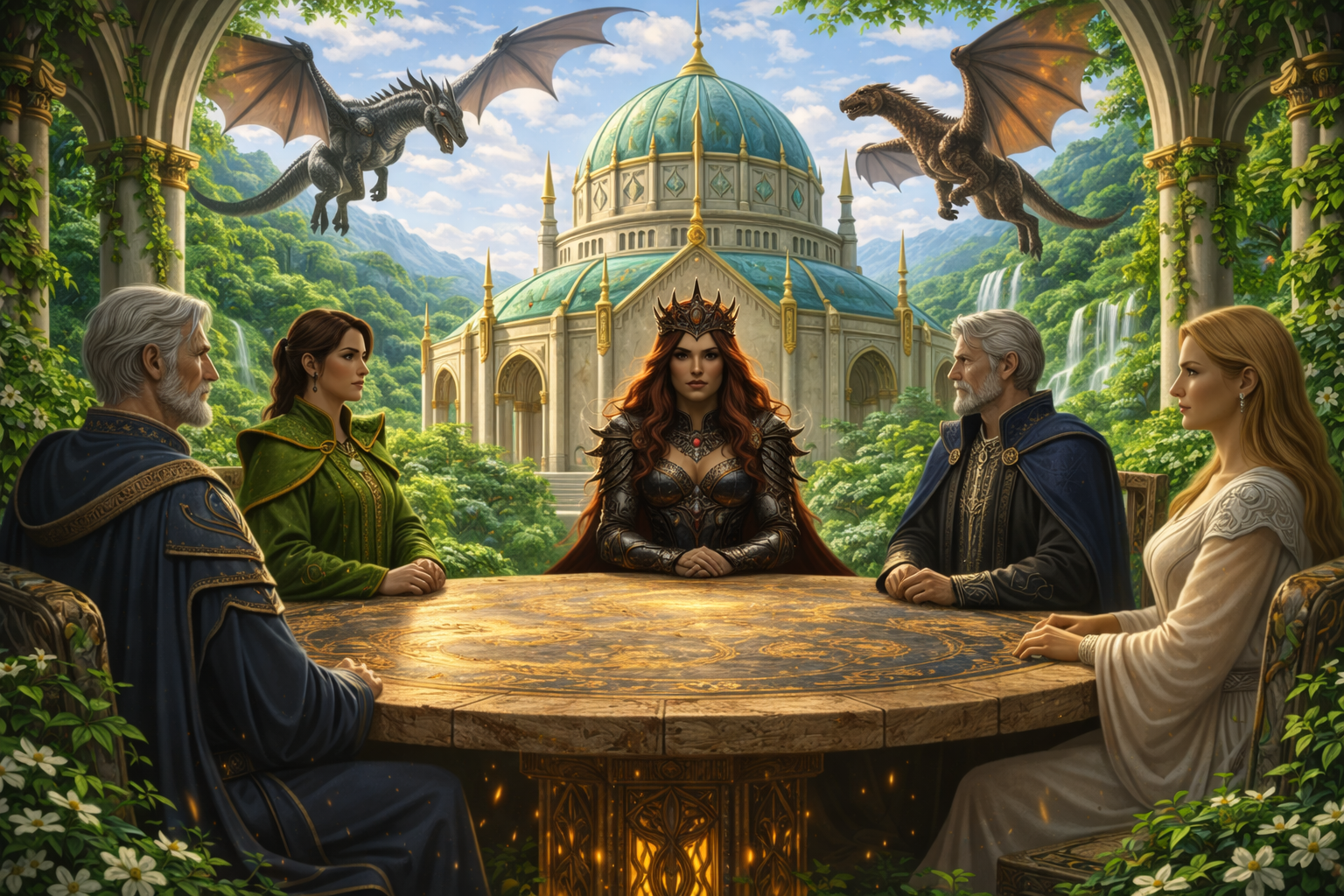
The dragons were not domestic creatures, nor latent weapons, as some had tried to understand them. They were born from the interaction of planetary fire with living will — regulatory systems of Eden, biological manifestations of its internal balance. They did not respond to commands and did not tolerate force. Every attempt at direct control had been met with rejection or destruction.
Daiana never attempted to control them.
When she was appointed to study the first active nests, she did not come with instruments of constraint, but with patience. She spent years observing them, adapting her presence to their rhythm, accepting long periods of rejection. She did not view them as subjects of study, but as entities that had the right to refuse.
The dragons recognized this.
Not because Daiana was stronger, but because she did not ask them to be anything other than what they were. Over time, they began to accept her. First as a tolerated presence, then as a reference point. She understood their cycles, their needs, their reactions to planetary imbalance. She spoke to them not through language, but through intention.
She became, without title and without proclamation, the mother of dragons.
Not in a biological sense, but in the profound sense of continuity. She was the one who watched over their growth, who limited their exposure to humans, who intervened only when fire risked becoming destructive. To the dragons, Daiana was not authority.
She was constancy.
In parallel, she had become one of Eden’s most brilliant minds.
Scientist, architect of deep energies, member of the Planetary Council — Daiana understood matter, energy, and genetics at a level few could reach. In a society built upon absolute control, she had been one of the central pillars of progress. Not because she believed in it blindly, but because she could make it function.
But there was a fracture others refused to see.
Eden’s society had chosen control over balance. Matter was shaped without limit, energy extracted without pause, genetics rewritten for efficiency. Emotions were treated as noise, art and creativity as waste. Children were programmed from an early age for precise roles so that nothing would remain unpredictable.
Progress had a cost.
To maintain its way of life, Eden had begun extracting energy directly from the planet’s core. The crust had been artificially stabilized, and internal imbalances were ignored or masked through optimistic reports. Models showed stability. Simulations confirmed control.
But the planet was not a model.
Daiana was the first to see the truth.
The core was becoming unstable. The pulses of fire were no longer natural. The stabilization fields would fail not gradually, but through a chain reaction impossible to stop.
When she demanded suspension of the exploitation, the Council refused. When she proposed relocating part of the population to Elrond, she was declared alarmist. Panic, she was told, was more dangerous than collapse.
The Council of Eden informed the Council of Elrond.
The response was identical: social control must not be weakened.
Soon, both councils decided that Daiana’s role was no longer necessary.
Her position was annulled.
Her authority was withdrawn.
The Passage was sealed by the Council of Elrond under the pretext of protection, under the oath of stability.
It was the first promise broken.
And reality recorded it.
On Elrond, nothing collapsed. Cities continued to float. Fluxes remained stable. The decision was archived as necessity.
On Eden, the fire began to burn differently.
Not chaotically.
Not violently.
But tensely.
The old oaths began to weigh. Not as pain, but as moral pressure. Eden had remained faithful to its oaths, while the other world had chosen to circumvent them.
This was not a temporary mistake.
It was a direction.
The sealing of the Passage produced no noise.
No explosion.
No shockwave.
On Elrond, the decision was archived as a preventive measure. On Eden, the fire continued to burn, cities remained alive, oaths were respected. On the surface, nothing seemed lost.
But Eden was not a world that reacted on the surface.
It was a world that felt in depth.
Daiana remained upon the Throne of Fire long after the fluxes had stabilized. The Throne did not speak to her. It did not show her the future. It showed her only what had already changed: absence.
Not absence of connection.
Absence of recognition.
For the first time, Eden was whole, but alone.
Not abandoned in haste.
But excluded by reason.
Daiana understood then that the oaths had not been openly broken. They had been bypassed. And that the most dangerous form of betrayal is not violence, but justification.
She spoke no word.
She demanded no explanations.
She sent no messengers.
But in that moment, something fractured within her identity.
Not the throne.
Not the oath.
Her name.
Queen of Eden was no longer sufficient for the world beyond.
And when a world refuses to recognize your name, it begins the process by which it will give you another.
Daiana did not yet know that name.
But Eden, the fire, and the silence between worlds had already begun to prepare it.
In that moment, Daiana understood that the planet could no longer be saved through words.
She made her own decision.
To prevent Eden’s self-destruction, she gave the order no one had believed possible. Not as queen. Not as scientist. But as guardian of equilibrium. The dragons were released. The cities burned. The infrastructure was destroyed. The population was lost — not out of hatred, but to stop the final rupture of the core.
The planet survived.
The civilization did not.
Elrond did not react to Eden’s fall with panic.
It reacted with calculation.
In the Citadel of Balance, the Wise gathered not to mourn a lost world, but to evaluate consequences. Eden had become unstable. The Throne of Fire had activated. Daiana had risen. These were not tragedies — they were variables.
For the first time in ages, Elrond felt something close to discomfort.
Not fear.
Not guilt.
But risk.
“Eden chose fire,” they said.
But the truth was simpler: Eden had been left without answer.
In the Citadel’s archives, the old oaths were still intact, engraved in pure crystal. None had been officially annulled. None had been reaffirmed. Ambiguity had become method.
And Daiana — Slayer — could no longer be ignored.
Not because she was dangerous.
But because she was coherent.
She did not ask forgiveness.
She did not beg for alliances.
She sent no messengers.
She existed as the direct result of their decisions.
And that made her unacceptable.
It was not called punishment.
It was called a stabilization measure.
The Wise decided that Daiana must not be destroyed. Destruction would create martyrs. It would leave traces. It would generate echoes. Instead, she had to be removed from time.
Eden, already collapsed, was the ideal place.
The plan was not discussed with Eden.
The population’s consent was not sought.
The Throne was not acknowledged.
They acted quickly, coldly, precisely.
The Ancient Passage was reopened for a single operation.
Not for salvation.
For permanent closure.
The warriors of light were sent not as negotiators, but as executors of a decision that needed to appear inevitable. Daiana was approached with the language of order and balance, not with truth.
She was told that her presence had destabilized the fluxes.
She was not told that she had been abandoned.
That was the true betrayal.
The chains were not simple restraints.
They were inverted oaths.
Forged from dimensional laws and rituals of balance, they did not immobilize the body, but the will. Each link was a broken pact; each seal — a promise that had not been honored.
Daiana did not fight when they were activated.
She understood immediately.
This was not a capture.
It was an erasure.
The Throne of Fire was buried in the depths of Eden’s crust, transformed into a chamber of detention. Her army of dragons was sealed alongside her — not as military force, but as dangerous memory.
The final seal was spoken by a Wise who did not meet her eyes.
In that moment, her real name was erased from the archives.
Only the title remained — “Slayer.”
Not as recognition.
But as warning.