CHAPTER I — THE TWIN WORLDS
I.1 — Eden

Eden was a world built upon attraction.
Not merely as a physical phenomenon, but as a principle of existence. Everything that took form here was called back toward the crust, toward the core, toward that burning center where the planet carried both its weight and its meaning. Eden’s gravity was not a passive consequence of mass, but a living force that bound forms to their origin and did not allow them to forget where they had grown from.
The cities did not float.
They settled.
They grew directly from rock, stretched across mountains and volcanic plains like extensions of the crust itself. They did not dominate the landscape, nor did they avoid it.
They continued it.
The streets followed the ancient fractures of the earth, and the buildings rested upon the planet’s sinews, as though Eden itself had accepted their weight.
Eden had not been created to be conquered.
It had been created to endure.
Beneath the crust, the core was not pure energy, but fire and magma — an unstable heart, always in motion. From this fire, life was born, but so was danger. There was no promise of safety, only of transformation. The fire did not destroy arbitrarily; it consumed, reshaped, redistributed. It was the mechanism by which the planet corrected itself.
That is why the people of Eden neither worshiped it nor feared it.
They listened to it.
The planet pulsed in a rhythm that required no witnesses. Mountains rose and withdrew slowly, deep seas altered their currents, and the black plains of solidified lava preserved the memory of past burnings. Nothing was ornamental.
Everything had a role in the greater balance.
Eden did not offer perfection.
It offered resilience.
Fear was not absent because danger was absent, but because danger was acknowledged. The oaths that held Eden whole were not fragile words, but chosen bonds. As long as they remained intact, the world continued to breathe.
And yet, Eden could not exist alone.
Its fire required a counterpoint. Instability had to be balanced by order, and transformation by continuity. Without a world to absorb excess, to reflect and stabilize it, Eden would have burned too quickly, consuming itself in its own intensity.
I.2 — Elrond

Elrond was not born of stone, nor of fire.
There was no primordial explosion, no cosmic violence from which matter scattered into chaos. Its birth was silent, precise, almost reverent — like a formula spoken correctly on the first attempt.
The universe did not create Elrond by accident, but out of necessity.
It appeared where the laws of reality ceased to contradict one another.
Gravity did not pull downward. Time did not accelerate its flow. Light did not disperse. All entered into a rare accord, a mathematical harmony so exact that existence itself accepted the resulting form as stable.
The fundamental equations of the universe closed into a perfect circle.
And that circle became a world.
Elrond was the result of rules so strict that matter had no permission to err. Everything that existed there — light, energy, space — obeyed not by force, but by inevitability. Any deviation was corrected instantly, not through destruction, but through realignment.
Above the planet burned two suns, locked in precise balance so that the light would not cast deep shadows. Elrond’s core was not fire, but pure, constant energy, devoid of fluctuation. A source that did not consume or transform, but sustained.
Elrond floated within a halo of cosmic energy, like a jewel suspended in the palm of reality. It was not anchored and did not press upon nothingness. It was maintained by the perfect coherence of the laws that governed it.
The continents of Elrond were not continents in the ordinary sense. Vast crystalline plates rose above the planet, faceted like cosmic mirrors, suspended at varying altitudes. Between them flowed oceans of light — pure, liquid energy, gleaming like an inverted sky.
Gravity, on Elrond, did not dictate.
It negotiated.
Cities were not built.
They were cultivated.
At first, small crystalline structures emerged from the surfaces of the suspended plates like seedlings of light. Over time, they branched, adapted, responded to the needs of those who lived there. The crystal was not alive in a biological sense, but functional: it reacted to mass, to stress, to flux.
When the wind passed through the spires, it did not produce noise.
It produced music.
A continuous song, almost subliminal, in which the inhabitants lived without consciously hearing it anymore. Elrond did not speak.
It resonated.
And yet, Elrond could not exist alone.
Its perfection required a world that would burn, consume, transform. Without Eden, Elrond would have remained an impeccable system — but inert, an order without becoming.
The worlds were not opposites.
They were twins.
And one could not survive without the other.
I.3 — The Citadel of Balance
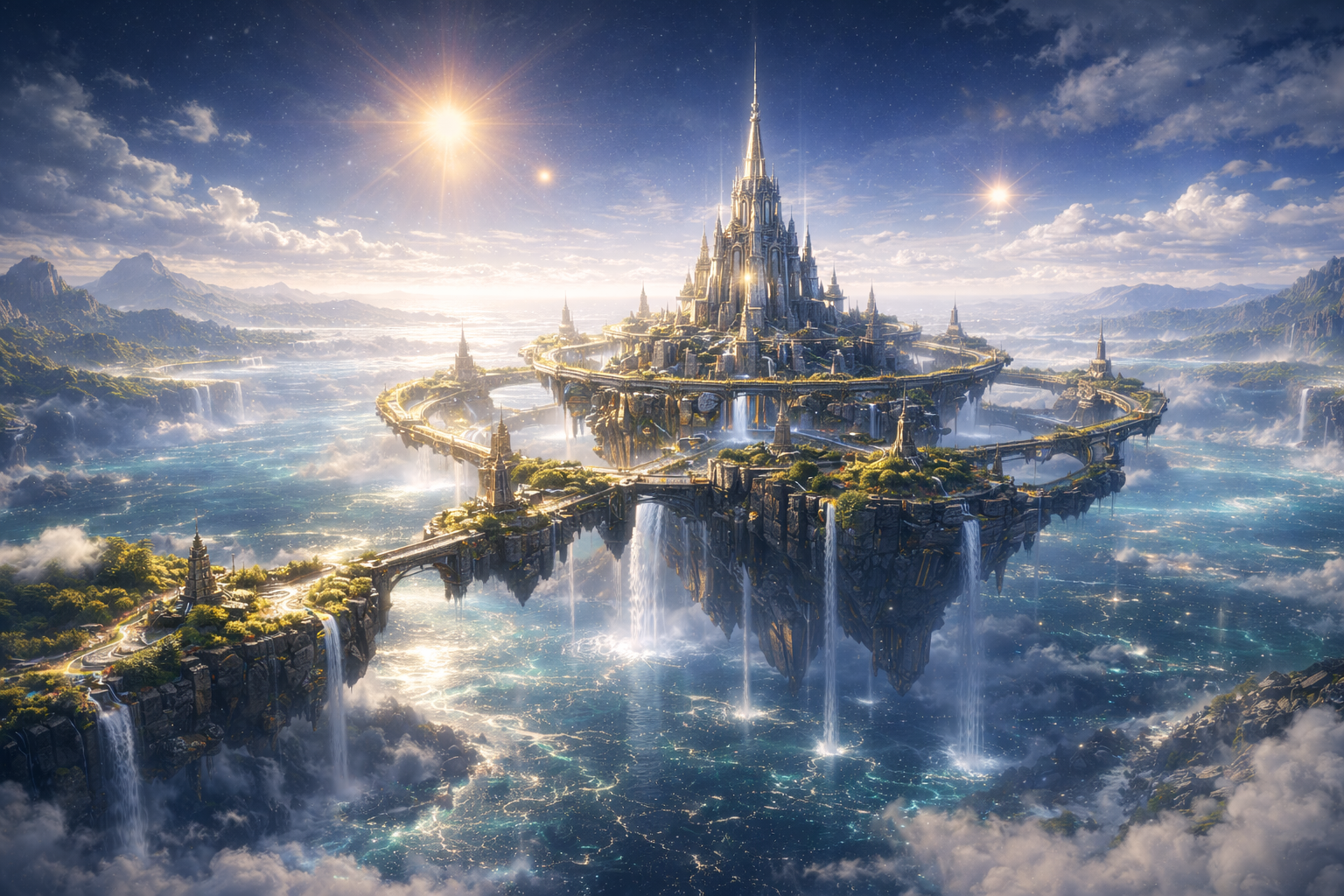
Above all the cities, beyond the suspended plates and the oceans of light, floated the Citadel of Balance.
It did not rest on anything visible. It was not anchored to the ground, nor bound to the sky. It existed at a point in reality where stability was so perfect that it required no support.
The Citadel did not overcome gravity — it ignored it.
From a distance, it resembled an impossible crown, formed of massive rings of stone and crystal, rotating slowly around a central tower. Each ring had its own function, its own rhythm, its own frequency. Some housed council chambers, others gardens of light, others observatories that gazed not at the stars, but between them.
No one remembered the construction of the Citadel.
Not because it had been lost to time, but because it had never been built by hands.
The Citadel had grown from Elrond’s core in the earliest moments of its existence, an automatic response of the planet to its own birth. It was the result of an inevitable reaction: where absolute equilibrium exists, there must also exist a center to maintain it.
Inside, spaces were not fixed. Halls reconfigured themselves according to those who crossed them. Walkways appeared and disappeared, materializing precisely where needed. Light did not come from visible sources; it seemed to be born from the air itself, filtered through the crystalline structure.
The Citadel was not merely the seat of power.
It was the consciousness of order.
And the consciousness of order always has two faces:
one that protects
and one that conceals.
The Citadel’s archives were the purest in the galaxy. Every event, every fluctuation, every ancient war had been recorded and arranged. And yet, there were places where the crystal did not “sing” the same music.
Voids.
Deliberate silences.
Pages not missing by accident, but by choice.
In such a world, erasing a name was not a simple political manipulation.
It was a metaphysical condemnation.
To no longer exist in Elrond’s archives meant to no longer exist in its order.
And yet, in the depths of the universe, someone sat upon a throne of fire and whispered her name in silence.
At the heart of the Citadel burned the Core Flame.
It was not fire in the known sense. It did not consume. It did not destroy. It emitted no heat. It was a singularity of balance — a point where the forces of the universe were held in perfect tension. Gravity, time, space, and energy met there not to cancel one another, but to synchronize.
The Flame pulsed.
Not randomly.
Each pulse was a response to the state of the universe. When dimensional fluxes were stable, it pulsed calmly, almost imperceptibly. When somewhere, in another world, a fracture occurred, it pulsed stronger, like a heart sensing pain before the mind understands it.
All of Elrond was connected to the Flame.
Crystal towers adjusted their frequencies according to its rhythm. Oceans of light altered their currents. Even the sky shifted its hues subtly, reflecting the state of the planet’s core.
For most inhabitants, the Flame was a symbol.
A legend.
Something sacred, yet distant.
For the warriors, it was more.
It was their living oath.
And the oath, on Elrond, was not merely a word.
It was written in crystal.
Imprinted into armor.
Bound to reality like a code that cannot be broken without consequence.
I.4 — The Ancient Passage
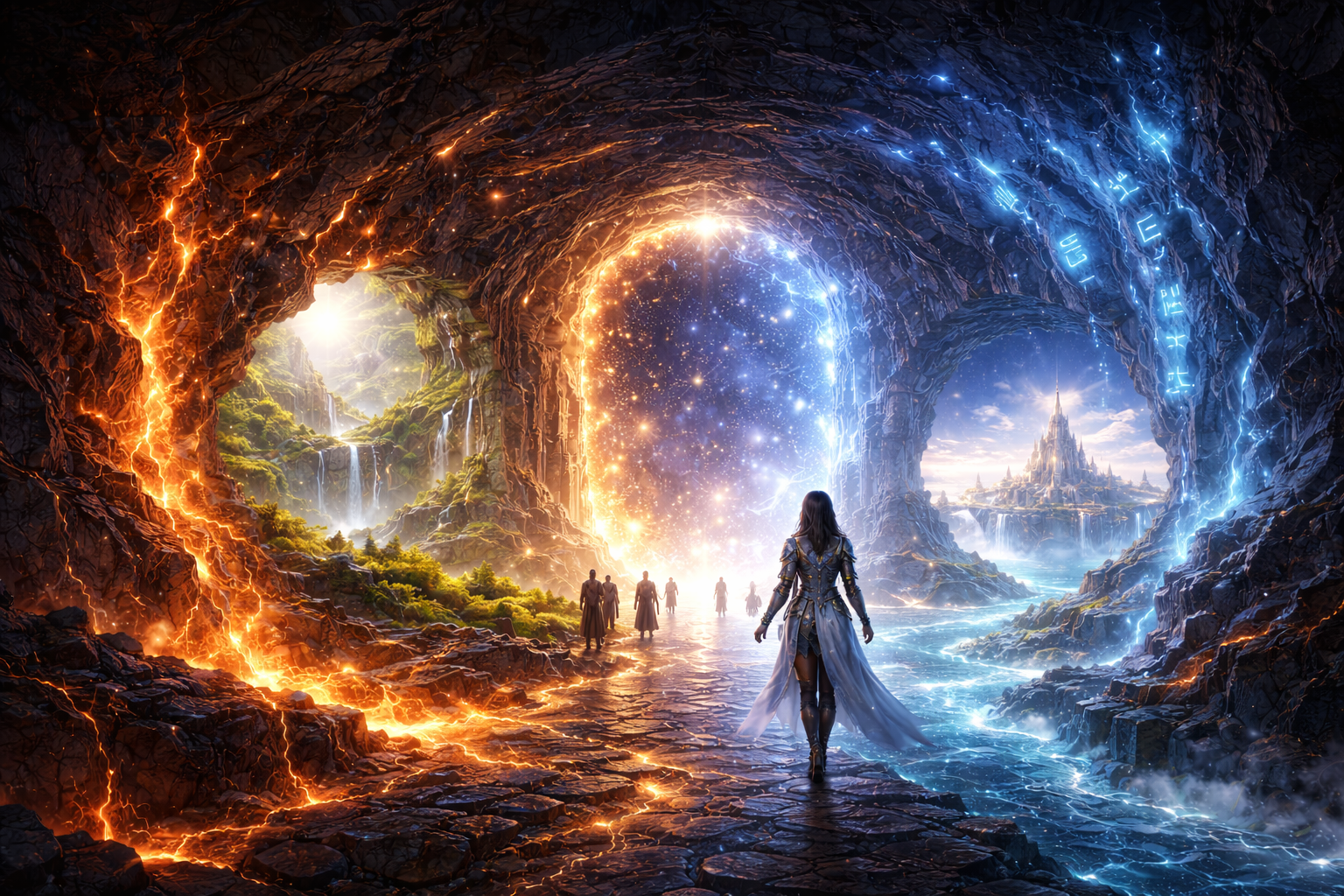
Between Eden and Elrond there existed a path.
It had not been built.
It had been discovered.
The Ancient Passage belonged to neither world, and yet it bound them both. It lay beneath the visible layers of reality, in a space where matter and energy were no longer in opposition, but in accord. There, the laws that governed Eden and those that ordered Elrond did not negate one another, but coexisted in a fragile, functional equilibrium.
It was not a gate, because it did not delimit.
It was not a bridge, because it did not force crossing.
It was a stabilized wound in the fabric of worlds — an ancient opening accepted by existence itself.
Through the Passage, not only beings traveled.
Ideas crossed it before bodies. Intent preceded steps. Eden’s fire and Elrond’s light touched there without canceling one another, without domination. In that space, will and reason recognized each other as different — yet legitimate.
That is why the Passage was not merely a means of travel.
It was a mechanism of balance.
As long as it remained open, neither world could claim absolute supremacy. Eden remained alive without becoming chaotic. Elrond remained ordered without becoming inert. The existence of the other functioned as an unspoken limit — a mirror reflecting not image, but consequence.
Authority over the Passage did not belong to a single ruler.
It had been entrusted to the Councils, not as a right of possession, but as a responsibility of stewardship. Their role was not to control the Passage, but to guard its stability, to decide when flows might be regulated and when they must be left to run freely.
This authority existed only as long as the oaths were honored.
Once, the Passage was crossed without fear. Not because danger did not exist, but because intentions were transparent. Crossing required no permission.
Only coherence.
No one could step from one world into the other while carrying within them an unresolved lie.
Back then, the oaths still held.
The Ancient Passage was not important because it connected two planets.
It was important because it compelled them to recognize one another.
And recognition — more than distance or difference — was the foundation of peace between worlds.